Chapter 1: Fake Recruiters and Impersonation
IN THIS LESSON
Fake Recruiters and Impersonation — What You'll Learn
How to recognize a fake recruiter or "NIL club" scam before you ever respond to it, based on real cases that have already targeted high school athletes
The exact four-step pattern these scams follow, from first contact to the hidden ask
The red flags that separate a real recruiting opportunity from a fraudulent one — including why a request for payment always disqualifies an offer, no matter how legitimate it sounds
Why no real recruiter or NIL opportunity ever needs your highlight film to come with a fee attached
How to verify any unsolicited recruiting contact through your athletic department before you engage
What to do the moment something feels off — and why reporting it costs you nothing
Risk: Four Real, Documented Cases
Case 1 — The Statewide NIL Club Warning. In 2025, the New Jersey State Interscholastic Athletic Association warned athletic directors and coaches statewide about scam emails and texts asking athletes and parents to sign up for fake school-affiliated NIL clubs with no connection to any real program (Press of Atlantic City, 2025).
Case 2 — The App-Based Version of The Same Scam. A near-identical scheme, an app called "NIL Club," prompted a Nevada school district to publicly declare that any communication from it should be treated as fraud, warning families that the app solicited fundraiser sign-ups carrying hidden recurring fees (Nevada Appeal, 2025). Neither of these first two schemes required any real athletic talent to target a student—a public roster and a school name were enough to make first contact credible.
Case 3 — The Long Con. Not every version of this scam is a mass text sent to hundreds of athletes at once. In Georgia, 39-year-old Malcolm Walker was arrested by Gainesville Police on charges of theft by deception after posing as a legitimate college recruiter who could arrange campus visits and help student-athletes get recruited (Sports Illustrated, 2025). Walker collected fees directly from families — one documented payment was $1,023 for a recruiting trip to Colorado—then repeatedly canceled the trip and stalled for months without refunding the money. One victim's family said he "kept blowing me off" for roughly six months. Investigators eventually learned multiple law enforcement agencies in different jurisdictions had received identical complaints about him. Walker built an audience of over 74,000 followers on Facebook, and that public following likely helped make him seem credible to the families he targeted.
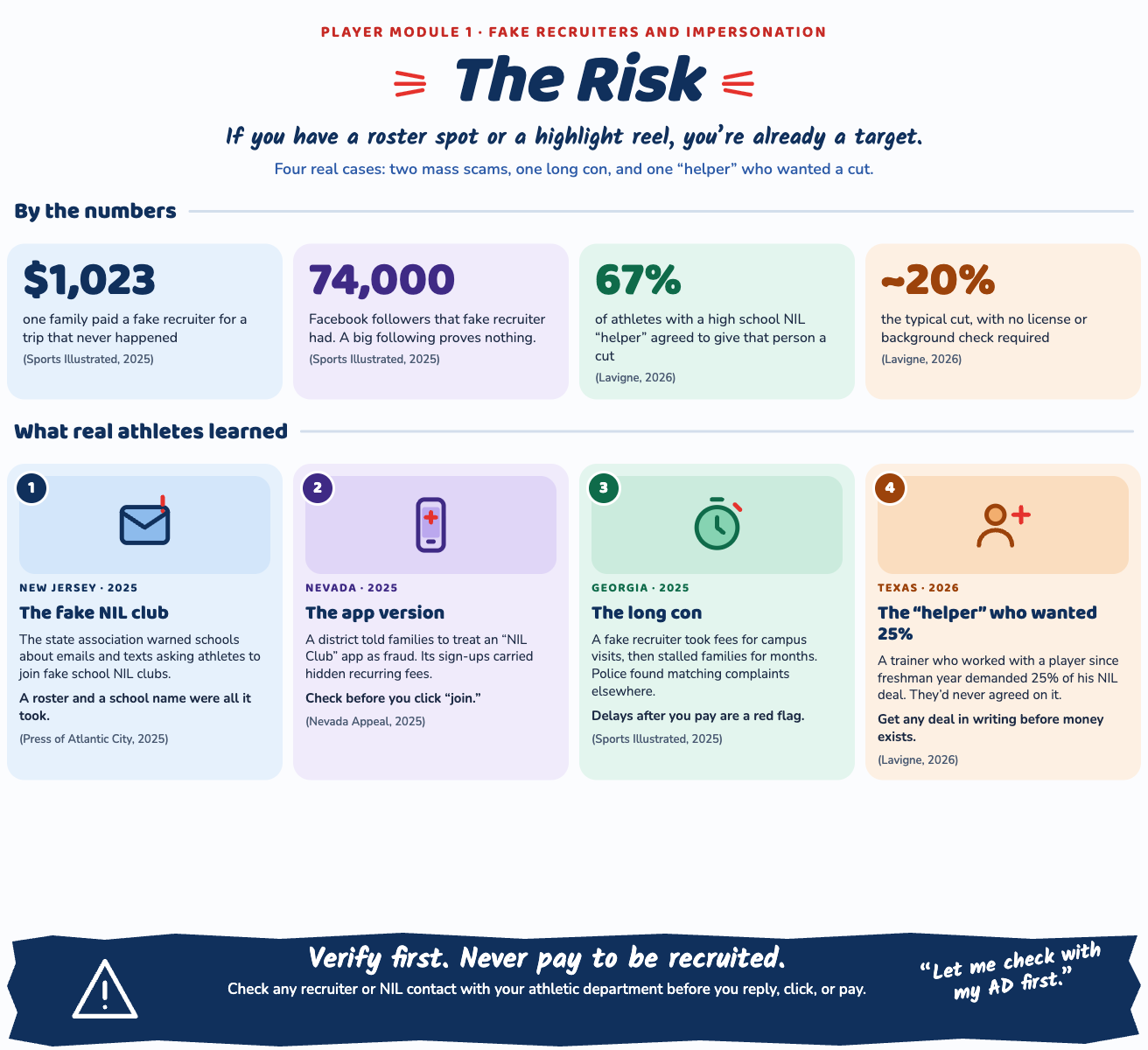
Case 4 — The Street Agent. This one looks nothing like the first three at first, because it doesn't start as a scam—it starts as a relationship. ESPN reported in February 2026 on the growing role of "street agents": informal, uncertified middlemen—often former players, trainers, or people claiming NIL connections—who attach themselves to athletes, sometimes as early as middle school, and later demand a cut of any NIL deal that results (Lavigne, 2026). Texas high school player Draden Fullbright began working with a man named Tony Jones during his freshman year at Terrell High School. After Fullbright committed to Oklahoma State with an NIL deal worth roughly $36,000 a year, Jones demanded 25% of it. When Fullbright said he'd never agreed to that, Jones sent a series of angry, expletive-laden messages accusing him of being ungrateful and indebted to him for the years he'd invested. Fullbright forwarded the messages to school administrators, and they eventually reached Oklahoma State officials, the American Football Coaches Association, and the Texas University Interscholastic League, which called them "inappropriate." One executive overseeing high school coaches in Texas told ESPN the problem is "almost at a crisis" (Lavigne, 2026). A survey cited in the same reporting found that 18% of college athletes had someone help them with NIL deals back in high school, and 67% of those athletes had agreed to give that person a percentage of their earnings — with a typical cut around 20%, and no registration, background check, or licensing requirement standing between an athlete and whoever offers to "help."
Why these four cases matter together: The first two are the same digital pattern operating at scale, the third is a single, patient scammer who used social proof instead of urgency, and the fourth is the hardest one to see coming, because it looks like mentorship for years before it looks like exploitation. A real threat to a young athlete's money doesn't always arrive as a stranger's text. Sometimes it's someone who's been in the athlete's corner since middle school—right up until there's real money on the table.
How It Unfolds
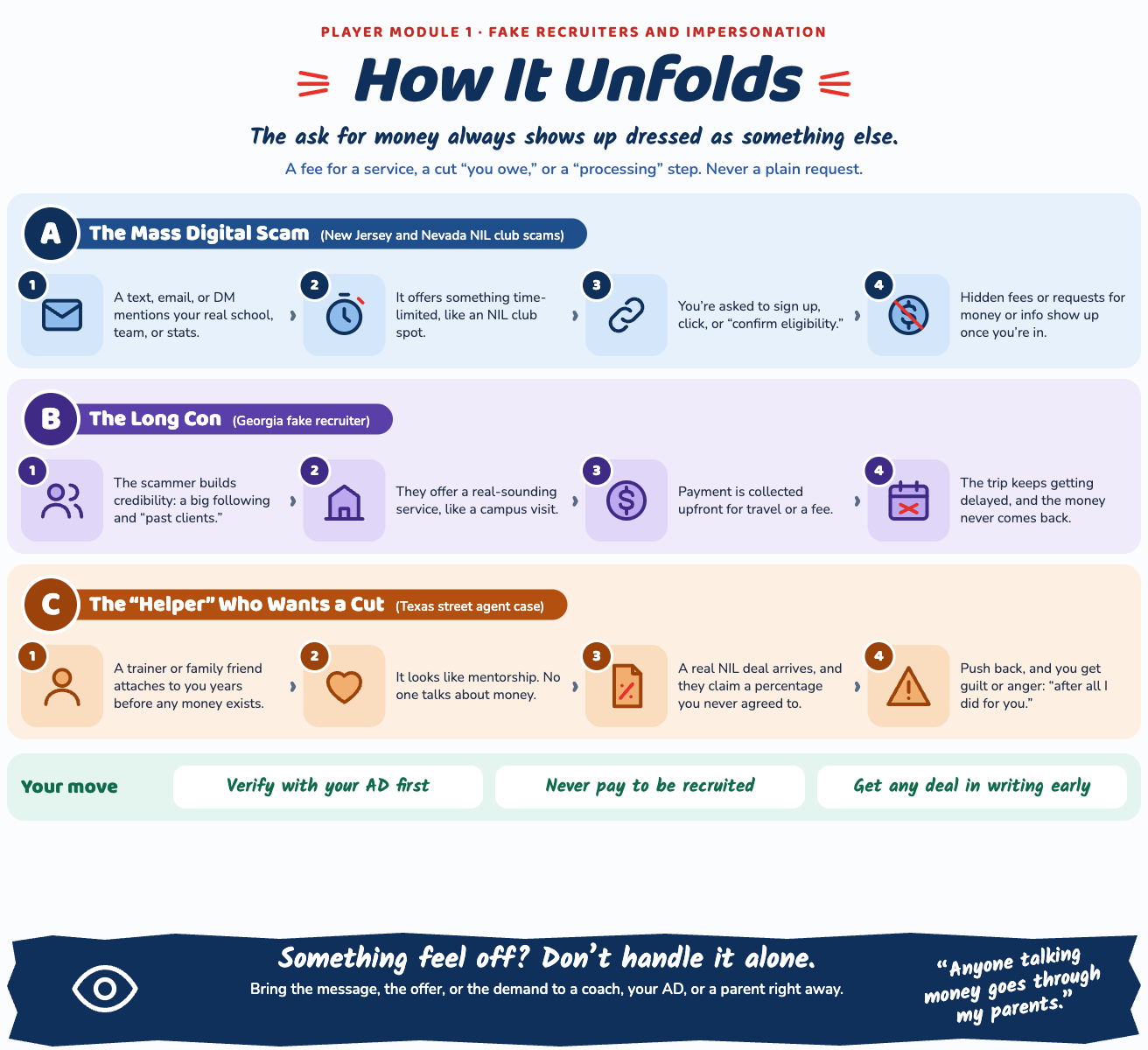
Pattern A — The mass digital scam (NIL club / fake recruiter text):
Contact arrives by text, email, or DM referencing the athlete's real school, team, or stats — usually pulled from a public roster or highlight page.
The message offers something time-limited: an NIL club spot, a "fast-tracked" recruiting conversation, or a fundraiser opportunity.
The athlete is asked to sign up, click a link, or provide information to "confirm eligibility."
Hidden fees, a request for payment, or a request for personal/financial information surfaces once the athlete is engaged — often framed as routine paperwork.
Pattern B — The long con (in-person or sustained relationship, like the Walker case):
The scammer establishes credibility over time — a public following, testimonials, a plausible history of "past clients."
A specific, real-sounding service is offered: arranging a campus visit, connecting with a coach, handling recruiting paperwork.
Payment is collected upfront for a real-sounding cost (travel, a visit, a service fee).
Delivery is delayed indefinitely with excuses, and the money is never returned — by the time a family realizes it's a scam, months may have passed.
Pattern C — The embedded exploiter (street agents, like the Jones/Fullbright case):
Someone genuinely useful-seeming — a trainer, a former player, a family friend — attaches themselves to an athlete years before any real money exists, often in middle school or early high school.
The relationship looks like mentorship: training help, encouragement, introductions. No fee is discussed, because there's nothing to take a cut of yet.
Once a real NIL deal or scholarship offer materializes, the person asserts a claim to a percentage — sometimes without any prior written agreement — often framed around everything they've "put in" over the years.
If the athlete resists or questions the percentage, pressure escalates: guilt, anger, or a sense of obligation is used to enforce payment, since there's no contract and no regulator to appeal to.
All three patterns share one underlying truth: the ask for money or a cut always arrives dressed up as something else — a fee for a service, a percentage owed for loyalty, a "processing" step — never as a plain, upfront request that would be easy to say no to.
Red Flags
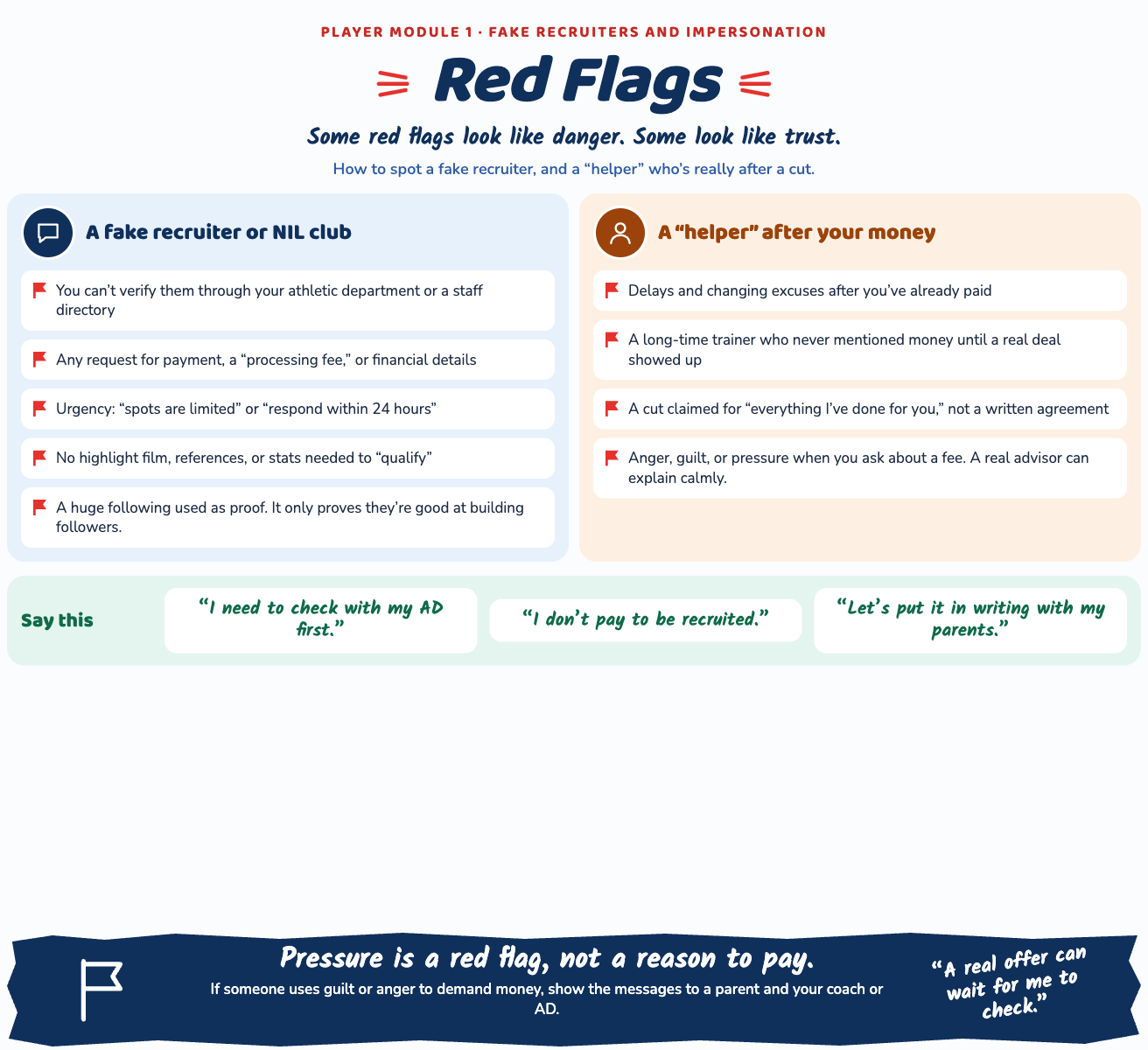
Contact that can't be verified through the athletic department or a public staff directory
Any request for payment, "processing fees," or financial details to participate
Urgency language ("spots are limited," "respond within 24 hours")
An offer that doesn't require any actual highlight film, references, or performance history to "qualify"
A large public following or online popularity used as a stand-in for actual verification—a big audience means someone is good at building an audience, not that they're a legitimate recruiter
Repeated delays or excuses after money has already changed hands, especially when the story keeps shifting
A long-standing helper or trainer who never discussed compensation until real money appeared, then claims a percentage based on "everything I've done for you" rather than a clear agreement made in advance
Anger, guilt, or intimidation used as a response to a question about a fee or percentage — a legitimate advisor can explain their rate calmly
Mitigation
Schools and associations should publish a single verified contact point for recruiting inquiries, brief coaching staff to recognize and flag impersonation reports immediately, and issue a standing advisory (as NJSIAA did) whenever a new scam pattern surfaces in the region. Families should also be encouraged to verify any independent "recruiting service" — not just contact claiming to be from a specific school — through the athletic department or a recognized organization like the NCAA Eligibility Center before paying for anything. For the street-agent pattern specifically, coaches and athletic departments should get in front of the conversation early: Texas coaches have started involving high school coaches directly in the recruiting process specifically to watch for these middlemen, and programs should encourage any family working with a trainer or advisor to put compensation terms in writing before an athlete accepts help, not after a deal materializes.
Intent
The actor's goal is rarely the offer itself. Fake recruiter and NIL-club contact is built to harvest personal information, extract upfront fees, or establish enough trust to move the athlete to a less monitored channel where further exploitation follows. In the Walker case specifically, the goal was direct financial theft dressed up as a real service — no information harvesting needed, because the "product" being sold was trust itself. In street agent cases like Jones and Fullbright, the intent forms later: the relationship itself may start with genuine mentorship, but the absence of any upfront agreement leaves room for the helper to define their own compensation retroactively, once real money is on the table and the athlete feels a sense of obligation.
Player Action
Verify any recruiter or "NIL club" contact through the athletic department before responding to it
Treat any request for payment, application fees, or personal/financial information as disqualifying, regardless of how legitimate the offer sounds
Don't mistake a large social media following for proof of legitimacy — ask how to verify the service independently, not just how many people follow them
If a trainer, advisor, or "helper" is involved in your recruiting or NIL process at all, get any compensation terms in writing before a real deal exists — not after
If someone uses guilt, anger, or a sense of obligation to demand a cut you never agreed to, that reaction is itself a red flag, not a reason to comply
Report the contact — or the demand — to a coach or AD immediately rather than handling it alone
Scenario Exercise: What Would You Do?
Read each scenario, decide what you'd do, then check the reasoning below.
-
This maps almost exactly onto the Walker case. A large following and photos with other athletes can be real and still mean nothing about whether this specific offer is legitimate. The $400 upfront fee combined with "almost full" urgency is the same disqualifying pattern from the Red Flags list above. Verify independently through your athletic department or the NCAA Eligibility Center before making any payment, and loop in your coach or AD about the contact either way.
-
This maps onto the Jones/Fullbright case. The absence of any prior written agreement means "his usual 20%" isn't an actual obligation — it's a number he's asserting after the fact. The right response isn't to pay out of guilt or to ignore it either; it's to loop in a parent or guardian and your coach or AD immediately, the same way Fullbright brought the messages to his school. A genuine disagreement over a service someone provided is a conversation for the adults in your life to help navigate — it is not something to resolve alone under pressure.
Knowledge Check
-
Correct: b
Why this is correct: Legitimate college coaches and recruiting staff do not charge athletes a fee to be contacted, evaluated, or "fast-tracked." A payment request disguised as routine paperwork is the exact step where Pattern A turns from contact into theft, which is why the module treats any fee as disqualifying, no matter how small it is or how legitimate the offer looks.
-
Correct: b
Why this is correct: Scammers pull your school, team, and stats from public rosters so their first message feels credible, and they add urgency so you reply before you check. Your athletic department can confirm whether a contact is real through official channels, and a genuine opportunity will still be there after a short verification step.
-
Correct: b
Why this is correct: The New Jersey and Nevada warnings both involved schemes that targeted students using only a public roster and a school name. Because no highlight film or performance history is needed to "qualify," every athlete on a public roster is a potential target, and an offer that asks nothing about your ability is a warning sign in itself.
-
Correct: b Why this is correct: Malcolm Walker had more than 74,000 Facebook followers, and that audience helped him look credible to the families he took money from. A large following shows someone can build an audience, not that they are a legitimate recruiter, so verification through your athletic department or the NCAA Eligibility Center still has to come before any money changes hands.
-
Correct: A
Why this is correct: Investigators learned that multiple law enforcement agencies in different jurisdictions received identical complaints about Walker, which connected the separate victims into one case. The lesson for athletes and families is that reporting matters: a single report can be the piece that links a pattern together and stops a scammer from reaching the next family.
-
Correct: b
Why this is correct: Without a prior written agreement, a percentage named after the money appears is a claim, not an obligation. Draden Fullbright handled the same situation by forwarding the messages to school administrators, which brought in Oklahoma State, the AFCA, and the Texas UIL. Guilt and anger are pressure tactics, and the adults in your life are the right people to help you respond to them.
-
References
Lavigne, P. (2026, February 23). 'Street agents' exploiting athletes in NIL deals, coaches warn. ESPN. https://www.espn.com/college-football/story/_/id/47976859/street-agents-exploiting-athletes-nil-deals-coaches-warn
Nevada Appeal. (2025, June 10). District warns families of NIL scam targeting athletes. https://www.nevadaappeal.com/news/2025/jun/10/district-warns-families-of-nil-scam-targeting-athletes/
Press of Atlantic City. (2025). NJSIAA warns ADs, coaches of scams asking players to sign up for fake NIL school clubs. https://pressofatlanticcity.com/sports/high-school/njsiaa-warns-ads-coaches-of-scams-asking-players-to-sign-up-for-fake-nil-school/article_2f8e2c3c-2a69-11ef-aff4-c7c079a5c705.html
Sports Illustrated. (2025). Fake College Recruiter Arrested: Malcolm Walker Scammed Families Out of Thousands, Police Say. https://www.si.com/high-school/fake-college-recruiter-arrested-malcolm-walker-scammed-families-out-of-thousands-police-say-01jp2s7h27mm